The Era of Prosthetics

clock

7 min

By Noah ROGNON, October 23, 2024

Prosthetics: Yesterday, Today, and Tomorrow

prosthetic

Prosthetics have come a long way from the rudimentary attempts to replace lost limbs. Today, thanks to advancements in biotechnology, robotics, and artificial intelligence, they not only restore functionality but push the very boundaries of what the human body can achieve. On the horizon, innovations promise devices capable of interacting directly with the brain, enhancing touch, and even surpassing natural capabilities. But how far will we go?

The Evolution of Prosthetics Through the Ages

The First Prosthetics

The earliest prosthetics, dating back thousands of years, were often made of wood or metal. Their sole purpose was to compensate for a physical loss.

For example, a wooden leg found in Ancient Egypt, over 3000 years old, already illustrates the desire to restore mobility.

However, these devices were rigid, heavy, and uncomfortable. With the Industrial Revolution, lighter materials like steel and leather were used, slightly improving their comfort.
Modern and Bionic Prosthetics

Today, we are far from the first rudimentary prosthetics. In the 20th century, major breakthroughs occurred, particularly after World War II, where the demand for artificial limbs led to significant advancements.

Motorized limbs, capable of mimicking basic movements, began to appear.

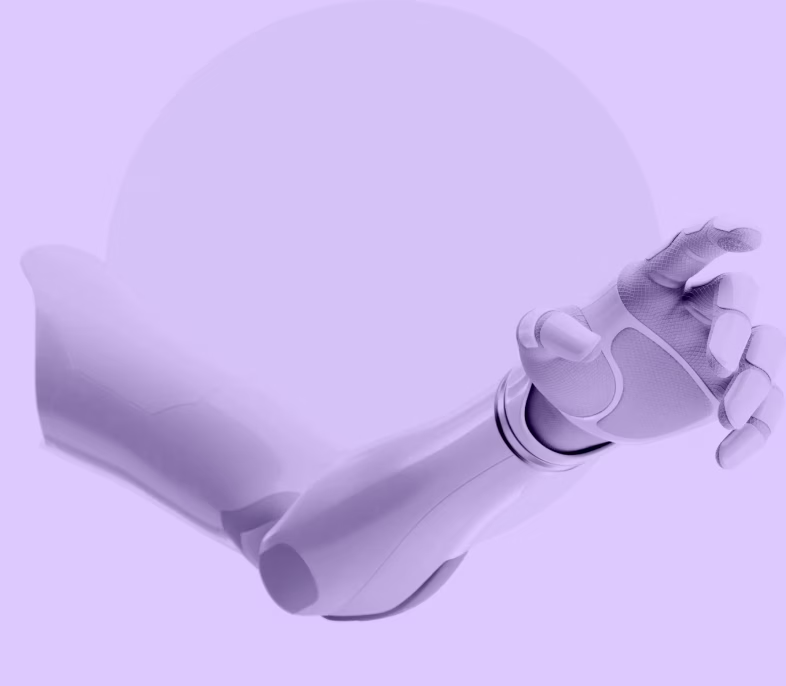
Now, bionic prosthetics with sensors, motors, and AI algorithms are pushing the boundaries of what is humanly possible.

prosthetic Modern Prosthetics, Atom Touch, Atom Limbs

Developed by Atom Limbs in 2022, the Atom Touch prosthetic represents a major breakthrough in the field of bionic limbs. This prosthetic integrates advanced neural sensors, allowing precise control by the user directly through nerve signals. Additionally, it provides tactile feedback through sensors capable of mimicking the sense of touch. This development paves the way for prosthetics that are not only functional but capable of restoring natural sensations, a key step toward improving the quality of life for bionic prosthesis users.

Modern Bionic Prosthetics: When Science Surpasses Fiction

“Today’s prosthetics no longer simply replace a limb; they become enhanced extensions of the human body.”

Bionic Prosthetics: Cutting-Edge Technology

The Case of Tilly Lockey: Natural Control of Bionic Limbs

Today, bionic prosthetics incorporate technologies that seemed like science fiction only a few decades ago.

Take the example of Tilly Lockey, a teenager using bionic arms equipped with motors and sensors to perform fine tasks, such as holding a glass or even playing music. These arms are connected to her nerves, allowing her to control them almost as if they were biological limbs.

Artificial Intelligence: A Prosthetic That Learns

Artificial intelligence has also enabled significant progress. Prosthetics like BrainRobotics integrate algorithms capable of “predicting” the user’s movements based on neural signals sent by the brain.

These prosthetics literally learn to function more smoothly and naturally as the user continues to use them.

Biomimetic Materials: Comfort, Appearance, and Performance

What makes these prosthetics even more impressive is the introduction of biomimetic materials, substances capable of imitating human skin and muscles.

These materials not only improve the comfort and appearance of prosthetics but also offer a level of strength and flexibility that older materials could not achieve.

What Does the Future Hold for Prosthetics?

Prosthetics That Surpass Humanity

The prosthetics of the future may no longer be limited to imitating human limbs but surpassing them. Imagine a prosthetic that gives you superhuman strength or ultra-fast reaction speed. These ideas, which sound like something out of movies such as Iron Man, are already being tested in laboratories.

Technologies in Full Development

The company Open Bionics, for example, is working on prosthetics that allow users to feel textures and temperatures, thanks to integrated tactile sensors.

Ethical Challenges to Overcome

But these advancements are not without ethical questions. How far should we go in enhancing human capabilities? If a prosthetic can make someone more capable than a person with biological limbs, how do we manage the resulting inequalities?

Scientists, doctors, and lawmakers will need to adapt quickly to these new challenges as the boundary between human and machine continues to blur.

The Evolution of Prosthetics: From Antiquity to the Bionic Era

500 BC
Wooden Prosthesis
(Ancient Egypt)
1536
Metal Prosthesis by Ambroise Paré
(France)
1863
Prosthesis with Knee Joint
(United States)
1946
Motorized Prosthetics
(World War II)
1980
Myoelectric Prosthetics
2012
Bebionic 3 Prosthesis
2022
Atom Touch Prosthesis

Legend

See More